

Why Does Every App Suddenly Need AI?
My honest breakdown of the gold rush nobody asked for.


“Just because we can, doesn’t mean we should.”
That line feels more relevant now than ever. Because somewhere between innovation and obsession, the tech world quietly changed. AI stopped being a breakthrough feature and started becoming a default checkbox.
But the strangest part is that most of us barely stopped to ask why.
You open your phone. Pick any app for example your food delivery app like “UberEATS”, your notes app, your PDF reader and I’ll bet there’s a little sparkle icon somewhere that didn’t exist two years ago. Click it. It’ll offer to “summarize,” “suggest,” or “enhance” something that was working perfectly fine before.
Welcome to 2026, where your alarm clock wants to use machine learning to predict when you’ll wake up.
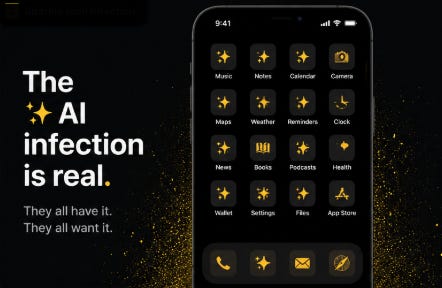
So, what’s actually going on? Is this genuine innovation, or are we watching the largest collective FOMO episode in tech history? As someone knee-deep in CSE coursework, you’ve probably already built a project, slapped a GPT API call on it, and called it “AI-powered.” No judgment and I’ve done it too. But let’s actually think through why this is happening and what it means for us.
The VC Money Explanation
Let’s start with the unsexy truth: a huge chunk of this is financial pressure.
When ChatGPT hit 100 million users in two months faster than any app in history investors panicked. Not in a “we should understand this” way, but in a “our portfolio companies need to say AI in their next pitch deck” way.
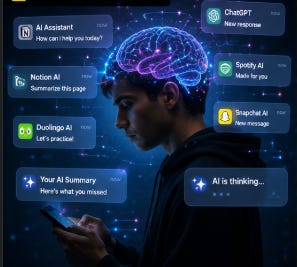
So, product managers at every company got the same memo: add AI or explain why you didn’t. It’s not entirely cynical investors genuinely believe AI will restructure entire markets. But the downstream effect is that your to-do list app now has an “AI assistant” that does what an if input contains keyword block used to do.
Here’s the actual signal vs noise breakdown:
Real AI integration: GitHub Copilot, Notion AI (document understanding), Perplexity, Cursor.
Marketing AI: “AI-powered” filters that are just slightly better heuristics, “smart” recommendations that are still collaborative filtering from 2015, chatbots that are glorified FAQ search.
Your job as a student and eventually as an engineer is to tell these apart.
Did The Tech Actually Got Cheaper?
Here’s what changed that makes this wave different from the last three “AI summers.”
Until about 2022, running a halfway decent language model cost serious compute. You needed in-house ML teams, GPUs, months of fine-tuning. Only Google, Meta, and Amazon could casually throw this into products.
Then the API economy happened.
Let’s take Anthropic as an example.
Today, you can add a genuinely capable language model to your app with:
from anthropic import Anthropic

client = Anthropic ()
response = client.messages.create(
    model="claude-sonnet-4-20250514",
    max_tokens=1024,
    messages= [{"role": "user", "content": user_input}]
)
That’s it. You just integrated a model that can reason, summarize, translate, and write code in six lines. The marginal cost per API call is fractions of a cent. This isn’t like previous AI hype cycles where the tooling was a nightmare. The tooling is now embarrassingly easy, which means the barrier to adding AI to your app dropped from “hire a team” to “one weekend project.”
So, companies aren’t just doing it for show. The cost structure genuinely changed.
The Engagement Loop Nobody Talks About
There’s a subtler reason that product people understand but rarely say out loud: AI features are stickiness machines.
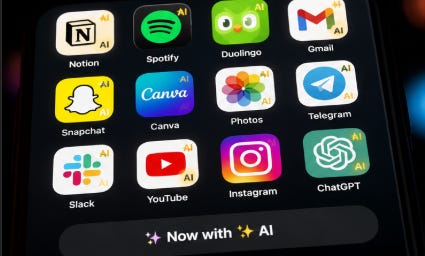
Traditional features add value and you’re done. Dark mode is great. You turn it on. You forget about it. It doesn’t make you come back.
AI features are generative they produce something new every time. And because they respond to your input specifically, they create a weird sense of personalization that’s hard to replicate. This is why:
Spotify Wrapped went from a yearly gimmick to a cultural moment after adding AI-generated summaries.
Duolingo’s engagement metrics spiked when they added an AI tutor (even though the pedagogy is arguably worse).
Snapchat’s My AI had 150 million users in its first month, despite most people finding it annoying at first.
The product insight is dark but real: people re-open apps to see what the AI says. It’s a variable reward loop. As a future engineer, you’ll have to decide how comfortable you are building that.
Three Categories of AI Features
After you strip the marketing, almost every “AI” feature falls into one of three buckets:
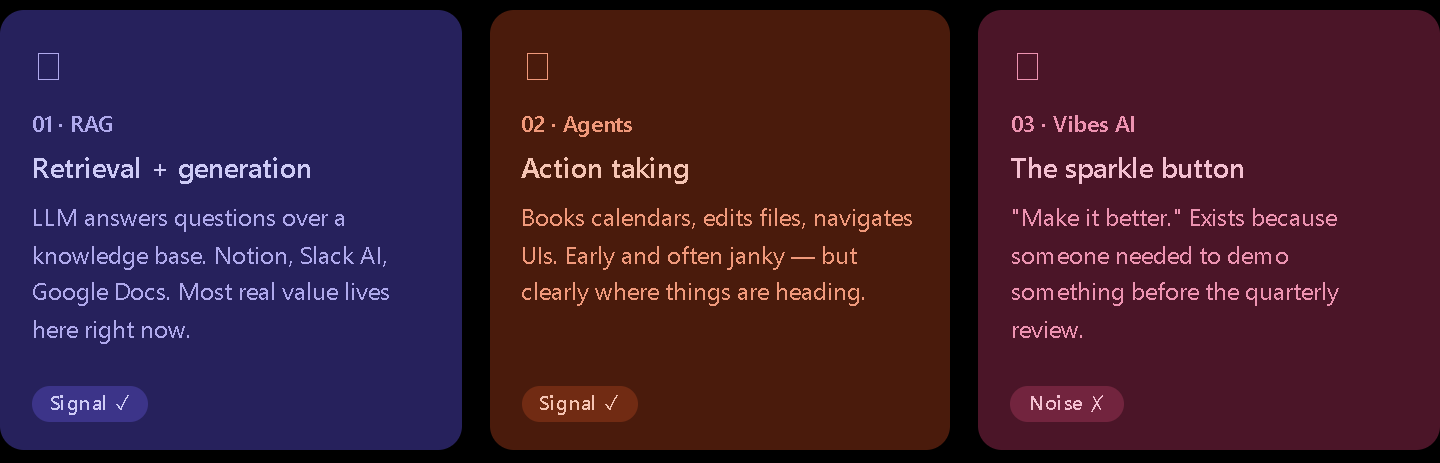
1. Retrieval & Generation (RAG): The app has a knowledge base (your documents, your data, their database) and uses an LLM to answer questions about it. Notion AI, Slack AI, Google’s “ask about this doc” all RAG. Genuinely useful. This is where the most practical value lives right now.
2. Action Taking (Agents): The AI doesn’t just answer, it does things. Books your calendar, writes and runs code, navigates a UI on your behalf. GitHub Copilot evolving into Copilot Workspace is this. It’s early and often janky, but it’s where the industry is clearly heading.
3. Vibes AI: A button that says “make it better” on your email draft. A loading screen that says “AI is thinking...” for 1.2 seconds before showing you a templated response. This is the noise. It exists because product teams needed to ship something before the quarterly review.
The job market will eventually separate engineers who understand bucket 1 and 2 from engineers who only know how to call an API and hope. Start building the former.
What This Means for You Specifically
You’re studying CSE or working as SDE right now, which means you’re entering the job market when “AI features” are going from novelty to baseline expectation. Here’s the practical read:
The skill that ages well: Understanding when not to use AI. Anyone can add an LLM call. The engineers who stand out are the ones who can look at a feature proposal and say, “a fine-tuned classifier does this better and costs 50x less” or “this is a regex problem, not a GPT problem.”
The skill that opens doors right now: Knowing how to build end-to-end with LLM APIs context management, prompt engineering, handling streaming, structuring tool calls, building evals. Not just a tutorial app. A real one.
The uncomfortable question to sit with: A lot of “AI features” are shipped because of investor pressure, not user demand. As the person writing the code, you’re not neutral in that equation. The features you build exist in the world. The to-do list app with AI that tracks your productivity patterns and nudges you back in is a product choice, not just a technical one.
The Actually Interesting Future Part
Okay, I’ve been a bit skeptical above. Let me be honest about the part that does feel genuinely different.
The apps that figured out what AI is actually good for uncertainty, ambiguity, language, context-switching are doing something we haven’t had before.
Linear (project management) added AI that can triage a bug report, connect it to related past issues, suggest an owner, and draft a response that all without the PM touching anything. That’s not a gimmick. That’s hours of coordination work disappearing.
Cursor (code editor) can hold the context of your entire codebase, understand what you’re trying to build, and make multi-file edits while explaining its reasoning. It genuinely changes how code gets written.
The pattern in the good ones: AI handling the context-heavy, ambiguous parts of workflows that humans find tedious, but machines find trivial. Not replacing decision-making. Eliminating the surrounding friction.
That gap between “AI that does the gimmick” and “AI that removes real friction” is where the interesting engineering problems live. And you’re in the right major to solve them.
TL; DR (For the Person Who Scrolled Here First)
Every app has AI because the cost to add it crashed and investors are demanding it
Most of it is noise, but the signal is real: RAG and agentic features genuinely change workflows
The skill to develop isn’t “how to add AI” and it’s “when AI is the right tool vs overkill”
You’re entering the industry at a weird but genuinely interesting moment
Build something real. Not a wrapper. Something where the AI is doing the hard, ambiguous part.
To Conclude this, if you think “Should I Care?”
Yeah, actually you should. But not because AI is magic, and not because every sparkle button deserves your respect. But because it is AI - era where the exact moment the industry is figuring out what this technology is actually for. That’s rare to be honest... Most engineers inherit a mature ecosystem. You get to help define this one.
The companies that survive this wave won’t be the ones that added AI the fastest. They’ll be the ones that added it right where it genuinely removed friction, saved time, or made something possible that wasn’t before. And the engineers behind those decisions? They understood both the tech and the why.
That’s the real opportunity sitting inside all this noise. Figure it out.
I hope this made you pause for a second and think about what kind of era we’re actually moving through right now.
Drop the comments below to share your thoughts!